I decided to glue 5 little mirrors onto the surface of the dish, at top, bottom, right, left and center :
closeup of one of mirrors:

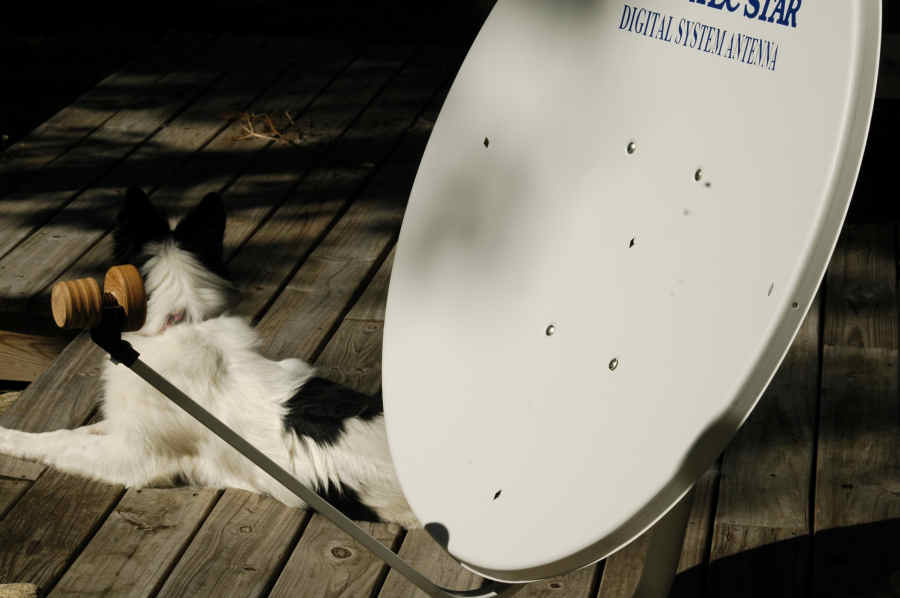
and I attached a fake LNBF into the holder,
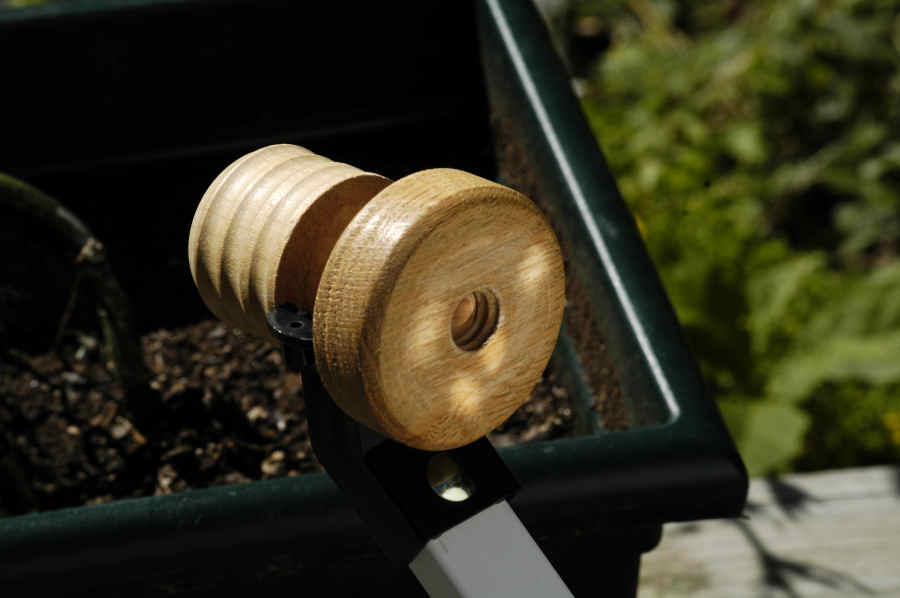
then moved the dish until the reflections from the 5 mirrors focused on the fake LNBF, as shown above. Well part of the problem, as can be seen in the picture below, is that the 5 reflections didn't coalesce into a single spot, which is evidence that the dish surface is not perfect, or that the lnbf arm wasn't located anywhere near the actual focal point.
Interestingly, I actually found one spot, about an inch above the LNBF holder, where 4 of the 5 mirror spots (all except the center spot) focused at the same point, however using this focal point would require bending the LNBF arm, which I didn't want to do at this point. But it does look like the dish seems to be shaped fairly well if another focal point would be used.
###############################################################
Being concerned about the fact that the 5 little mirrors don't all reflect to the same focal point, but not being sure if the thickness of the mirrors was altering the results, I decided to try to find a THIN mirror material, that wouldn't be substantially different from the surface of the dish.
I first tried gluing on small squares of aluminum foil. I thought this would work, however it wasn't a perfect enough reflector, and I wasn't able to see the spots on my fake lnbf.
Since I live in an area with natural mica, and having noticed how mica rocks will reflect the sun very well for hundreds of feet, I thought that might be a good surface, plus mica sheets can be separated to individual sheets that are much thinner than a sheet of paper, probably thinner than the paint on the dish. However, this didn't work either. I'm not exactly sure why. Perhaps when I separated the layers with a knife, I fractured the surface enough to ruin the optical properties.
Then I went to the hardware store, and got 2 things. First, I got some very reflective aluminized tape, which "seemed" to have good optical properties. However, again, this didn't work. Again, don't know why.
Finally, at the hardware store, in the automotive section, I found a sheet of mirror repair material. It is similar to thick aluminum foil, but of fairly good optical quality. You can cut it with sissors. I cut 5 little squares of this material, and glued them to the dish, as shown:
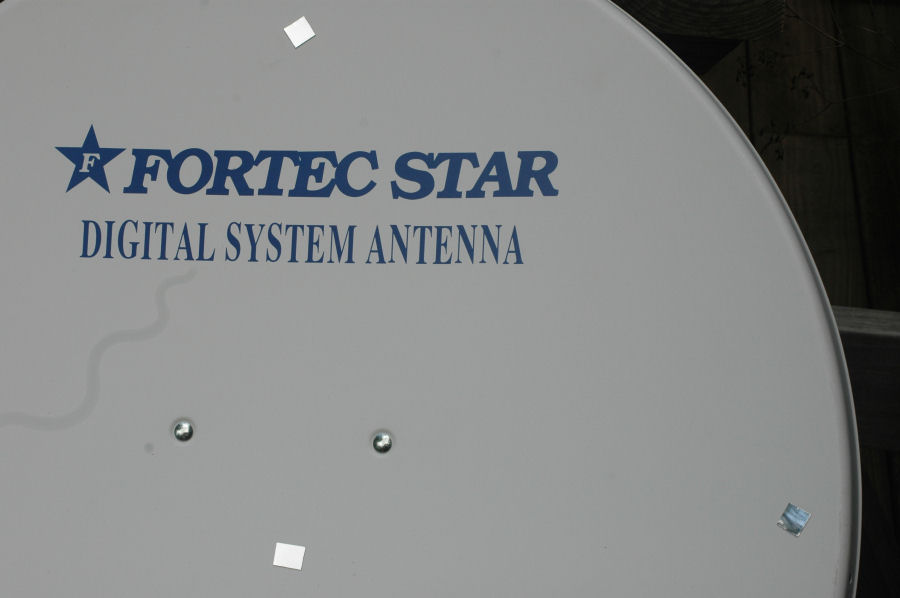
Anyway, this worked well. However, while slightly better than when using the thicker mirrors, it still showed that the different squares didn't reflect to the same points:
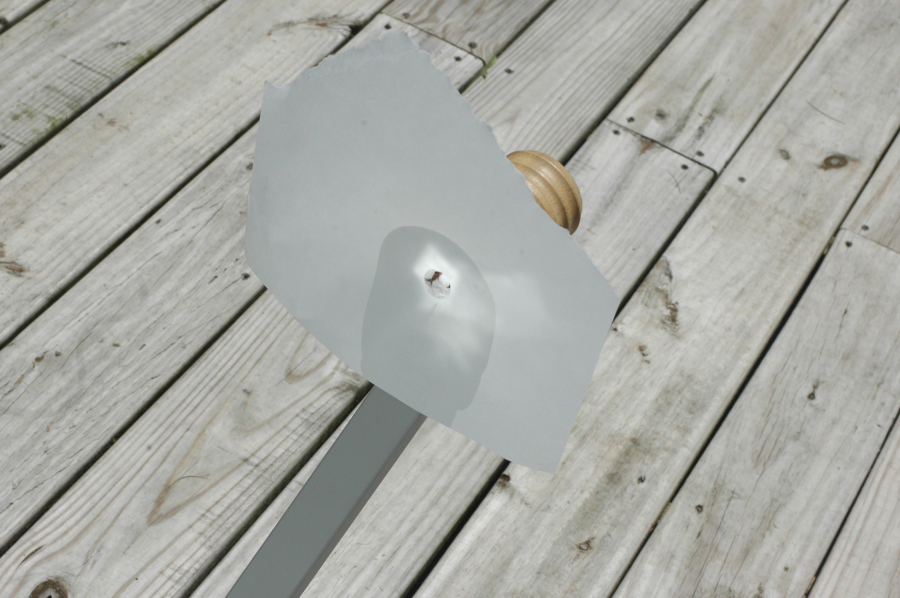
This seems to show 2 of the 5 squares reflecting at one point, but the other 3 being off center.
At this point, I again tried to find another focal point at which all 5 reflectors aimed at the same point.
What I found, was that above, and a bit to the left of the regular focal point, there was a much better focal point, where all 5 reflections came nearly together:
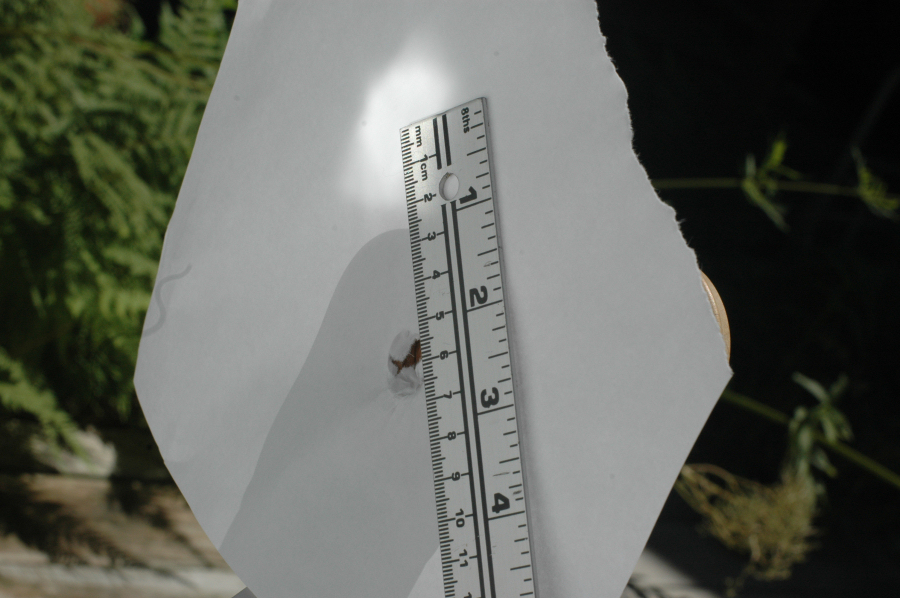
As you can see above, this was about 2.5" off center, and the surface of the paper was about 1" forward of the plane defined by the lnbf holder.
A couple years later, I decided to do the same experiment with my 10' Orbitron dish (which has now been trashed and replaced by a 10' SAMI). With the Orbitron, I couldn't get any 2 of the mirrors to focus anywhere near the same point at the same time, although it was not easy to move the big dish around. I concluded that the mesh surface was not flat or perfect enough to use just a few mirrors, although it's possible that I just wasn't able to move the dish around enough to find the perfect point. I did this at a time when the sun was crossing the proper azimuth, and was moving the elevation up/down, trying to find a focal point with a piece of cardboard glued to the front of the feedhorn. This experiment was a complete failure.
HOWEVER....... I really recommend the mirror experiment for small solid surface dishes. Basically, a parabolic sat dish will have only one focal point, and from what I've seen, either the manufacturers don't always put the lnbf holder at the right point, or that the lnbf holder might be bent.
##################